
This article summarises the final takeaways of a Finnish–Danish Joint Action, led by the Finnish Innovation Fund Sitra, which developed the Entries e-tools for the AI Act, Data Act and European Health Data Space (EHDS) regulation.
The European competitiveness challenge is often framed as a problem of “too much regulation”.
That diagnosis is convenient – but incomplete. The real issue is simpler, and more structural:
Regulatory failure is rarely prevented where it actually happens – at the early stages of an innovation journey.
It is often only discovered later, in audits, delays, redesigns, or difficult investor discussions. But by that point, key decisions have already been made on incomplete assumptions. Requirements that should have shaped design are instead discovered after the fact. Extended application timelines are often mistaken for leeway – delaying regulatory consideration instead of integrating it into early design. The cost is not just additional compliance effort – it is lost time and funds, misdirected development, and avoidable risk.
The Entries Joint Action set out to test a different premise: what happens if regulatory understanding can be established rapidly by digital means and is available early enough to influence decisions?
The results point to a clear shift.
From Compliance to Decision-making
When regulatory clarity is introduced early, organisations do not simply “learn compliance.” They change how they operate. Startups begin to design with requirements in mind instead of reacting to them later. Researchers start framing projects with a clearer path to application. Advisors can guide less experienced teams earlier and with greater precision.
Across hundreds of European users piloting the Entries tooling for the AI Act, Data Act, EHDS Regulation, MDR and IVDR, one user captured this precisely:
“We received our first insight and understanding on regulatory requirements, which may be hard to reach otherwise.”
Another described the practical impact even more directly:
“What Entries provided was not just about learning the principles but making sure we don’t miss design inputs drawn from regulations – because they would be hard to implement later.”
This is the real shift. Regulation stops being a checkpoint at the end of development and becomes part of how things are built from the start.
Making Regulation Usable
What is striking is that this change in behaviour did not require deep regulatory expertise. Many users were able to navigate complex EU legislation independently and iteratively, building understanding as their product evolved.
“Using the tool was possible without any prior in-depth regulatory experience.”
This matters because regulatory knowledge today is still too often concentrated, accessed too late, and disconnected from day-to-day decision-making. When that barrier is removed, the effect is immediate: confidence increases, risks become visible earlier and teams make more informed choices.
For some, the impact was decisive:
“We were really worried about regulatory compliance – Entries was game-changing.”
There is also a more uncomfortable conclusion behind these results. The problem is not that regulation is inherently too complex. It is that organisations do not engage with it early enough, and when they do, it is often in forms that are difficult to apply in practice. The issue is not the existence of rules, but the lack of clarity around how they apply in context.
The impact is reflected not only in qualitative feedback but also in consistent ratings: users scored strong support for learning (4.5 out of 5) and clarity on regulatory requirements (4.6), alongside high usability (4.3) and recommendation scores (4.6).
The Joint Action did not simplify regulation. It made it usable earlier.
That distinction is important. Simplification has limits. Clarity can scale.
Why This Matters Now
This becomes even more relevant in the current environment. Europe is entering a phase where multiple regulatory frameworks – from the AI Act to the Medical Device Regulation, from the Data Act to the European Health Data Space – begin to apply in parallel. None exist in a vacuum but together they form a landscape of regulations to interpret across.
For users, this complexity directly affects their ability to move forward with confidence.
In this regard Entries receives high notes from users:
“Navigation through the regulatory landscape couldn’t be more pain-free.”
At the same time, access to information is expanding rapidly through AI. Paradoxically, this does not make decision-making easier but makes it harder. Having more answers is not the same as making correct decisions.
In regulatory contexts, “almost correct” is rarely sufficient. Decisions must be complete, consistent, and traceable. This is where structured, deterministic approaches become necessary – not as a replacement for human expertise or AI, but as a foundation that makes reliable reasoning possible.
From Tools to Capability
What begins to emerge from this is something beyond individual tools. It is the outline of a new layer of capability – one where regulatory understanding is embedded directly into how innovation happens, rather than applied afterwards.
In this context, regulatory clarity is no longer just a compliance concern. It becomes a competitive factor.
In sectors such as health, AI, and data-driven services, the ability to understand and apply regulation early determines not only speed, but direction. Organisations that achieve this are not just avoiding mistakes but making better decisions from the outset. Because regulation defines feasibility, it is also foundational to the viability of the innovation.
Ecosystem as an Enabler
The role of ecosystem collaboration has also proven critical in this work. The results did not emerge in controlled environments, but in interaction with real innovators, researchers, and public actors. This ensured that the insights reflect actual behaviour under pressure, not theoretical assumptions.
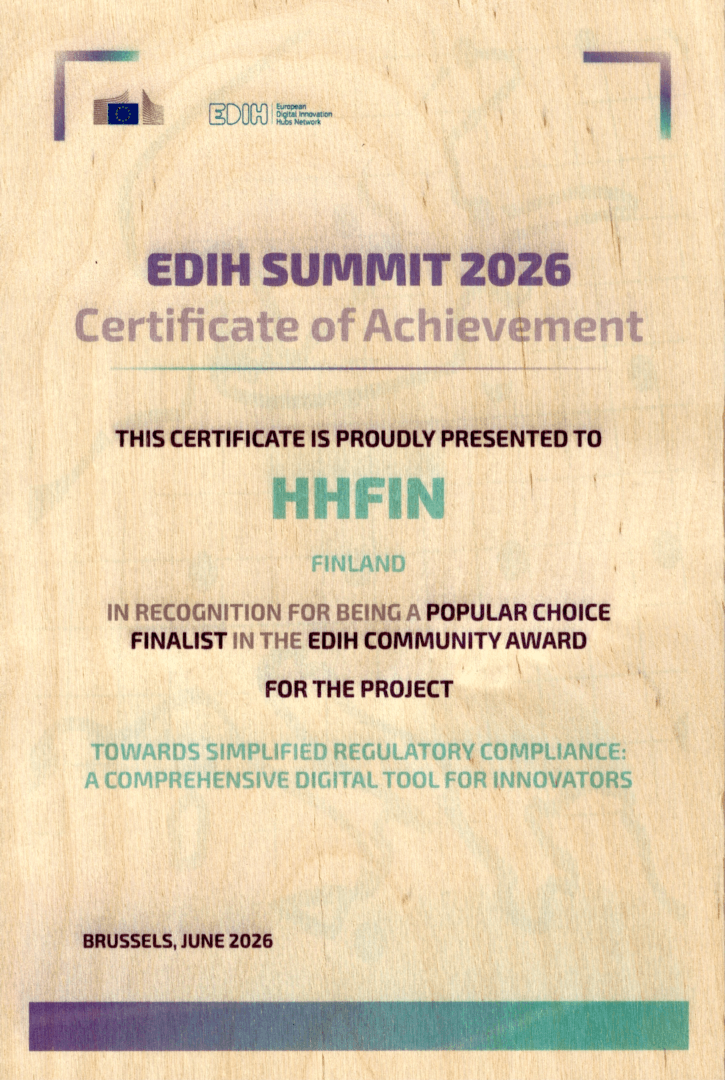
The broader relevance of this approach has been recognised beyond the immediate work. The initiative has been selected as one of the five finalists in the EDIH Awards 2026 among the 230 European cases. This signals that the value lies not only in the tools themselves, but in how regulatory understanding is activated across ecosystems.
Looking ahead
The implication is not that Europe needs less regulation. It is that European innovation needs to engage with it differently.
The central question is no longer how to reduce regulatory burden, but how to ensure that regulation is understood and applied in time. When that happens, regulation does not slow down innovation but guides it, as it is meant to.
Closing Thought
The narrative that regulation is a barrier to competitiveness has been repeated often. The evidence from this work suggests something more precise:
The real bottleneck is not regulation – it is the lack of regulatory clarity early enough to influence decisions.
Fix that, and the equation changes. Not gradually, but fundamentally.
For further information and requests, please contact any of the steering committee member of the joint action:
- Tiina Vainio, The Finnish Innovation Fund Sitra, , +358 50 524 6559
- Laura Halenius, The Finnish Innovation Fund Sitra, , +358 294 618 303 (Steering Committee Chair)
- Ville Peltola, Technology Industries of Finland and AI Finland network, , +358 40 553 9941
- Päivi Ahlgren, Healthtech Finland, , +358 40 193 7953
- Karen Lindegaard, Danish Life Science Cluster, , +45 2461 1931
- Ilona Raitakari, HealthHub Finland, European Digital Innovation Hub (EDIH), , +358 40 124 4956
- Teemu Moilanen, Finnish AI Region (FAIR), European Digital Innovation Hub (EDIH), , +358 40 510 7317
- Youssef Zad, Finnish Startup Community, , +358 40 593 3316
- Heikki Pitkänen, Lean Entries, , +358 44 238 0006
- Outi Tuovila, Business Finland, , +358 50 339 2542 (Monitoring Member)